
REFORM INDIA
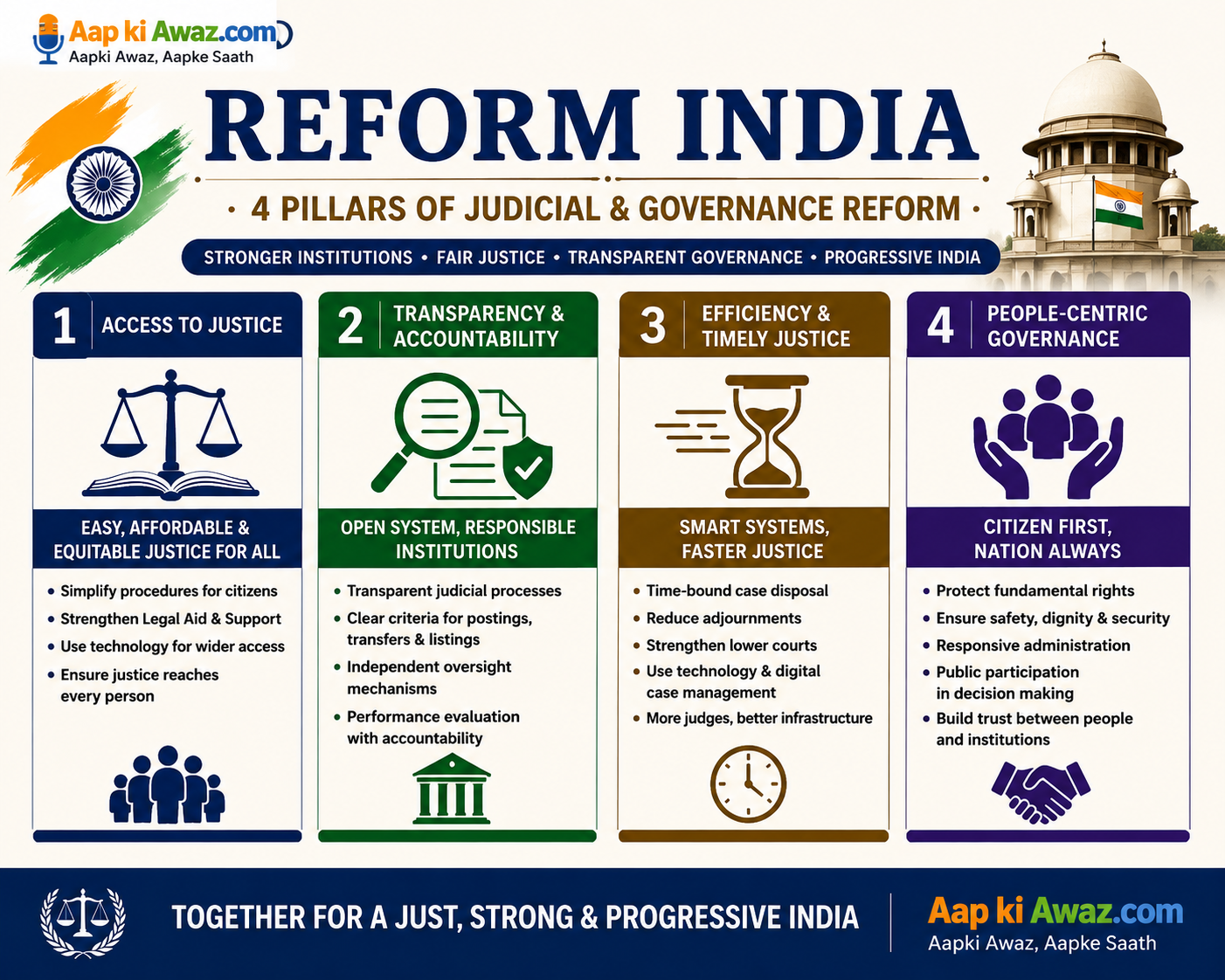
THE FOUR PILLARS OF DEMOCRACY
-
-
-
-
-
Legislature,
-
Executive,
-
Judiciary,
-
The Media.
-
-
-
-
These institutions prevent the concentration of power, protect citizen rights, and maintain government accountability.
3. REFORM INDIA: JUDICIAL REFORM
Part 1 — Theory:
- justice theory,
- global models,
- constitutional principles,
- judicial purpose.
Part 2 — Ground Reality
- pendency,
- corruption allegations,
- inconsistent precedents,
- litigation cost,
- investigation flaws,
- procedural delays,
- citizen suffering.
Part 3 — Constitution Bench / Landmark Judgments
- More than 200 landmark constitutional bench judgments. Article 14, Article 21, Article 141, natural justice, speedy trial, speaking orders, judicial accountability principles. Etc.
Part 4 — Reform Recommendations: 16 points.
Part 5 — Your Comments:
REFORM INDIA: JUDICIAL REFORM INITIATIVE
ADDRESS: I-102, BATLA HOUSE, JAMIA NAGER, NEW DELHI-110025. MOBILE:9213344558. E-MAIL: EDITOR@AAPKIAWAZ.COM.
RESPECTED SIR/MADAM,
1.1. The Applicant is a former official of the Ministry of External Affairs (ICCR) and the elected President of the ICCR Staff Association (1992). He is the Founder & Chief Editor of www.aapkiawaz.com.
1.2. A committed Whistleblower and petitioner-in-person, the Applicant has successfully filed multiple PILs before the Hon’ble Supreme Court and High Courts, consistently advocating against systemic corruption and for institutional integrity. and Founder & National President of Reform India (NGO) – a federation of employees’ organizations. The inaugural function was organized with collaboration of National Journalist Association, UNI & PTI Employees National Federation and Former Prime Minister, Home Minister, Broadcasting Minister, Chief Justice of India, Chief Justice of Mumbai High Court, Police Commissioner etc. are invited.
1.3. Objective of this Submission: Drawing from extensive first-hand experience—ranging from public administration to active journalism and personal participation in criminal proceedings—the Applicant has identified recurring procedural gaps. This paper seeks to highlight these systemic difficulties and proposes pragmatic solutions within the existing legal framework, aimed at assisting this Hon’ble Court in its constitutional duty to prevent any miscarriage of justice.
- WHY JUDICIAL REFORM?
“The mounting backlog of cases in our judiciary is not merely a statistical figure; it is the silent cry of helpless citizens losing everything in the wait for justice. The complexities and procedural failures of the current trial process have created a irony where ‘judicial delay’ acts as a boon for the accused and a curse for the victim. Consequently, fundamental principles such as Constitutional Rights, Natural Justice, and ‘Fair Trial’ have been obscured. In the absence of accountability, the fundamental right to justice has morphed into an expensive and endless tragedy. This petition is not just a plea for the disposal of cases, but an effort to restore the ‘Constitutional Discipline’ that ensures the shield of law does not become the armour of the corrupt.
-
- REFORM INDIA: 5-POINT JUDICIAL REFORM CHARTER:
3.1. POINT 1: CONSTITUTIONAL COMPLIANCE – MANDATORY APPLICATION OF ART. 141 (SC) & ART. 251 (HC)
3.1.1. The Core Issue: The trial court is the foundation of the Indian judiciary. Currently, adherence to orders under Article 141 (Supreme Court) and Article 251 (High Court) at the trial level has become merely ‘symbolic’. This constitutional failure is the root cause of pendency and judicial delay.
3.1.2. The Reality: It is an imperative of the Rule of Law that subordinate courts strictly follow the principles laid down by higher courts. In practice, these constitutional articles are merely ‘cited’ without being ‘executed’, eroding public trust.
3.1.3. The Reform Proposal: Constitutional Compliance Certificate: It shall be mandatory to attach a “Constitutional Compliance Certificate” with every ‘material order’ of a trial court.
3.1.4. Requirement: The Judge must explicitly state on record: “This order adheres to the principles established by the Hon’ble Supreme Court (Art. 141) and the High Court (Art. 251).”
3.1.5. Legal Consequence: Any order issued without this ‘Compliance Linkage’ shall be deemed technically ‘Non-Est’ (invalid).
3.2. POINT 2: DIGITAL TRANSPARENCY VIA VIDEO RECORDING:
3.2.1. The Problem: There is a lack of impartial evidence regarding actual court proceedings, leading to misrepresentation of oral orders and arbitrary recording by staff.
3.2.2. The Reform: Video recording of trial court proceedings must be made mandatory.
3.2.3. Basis of Equality: If Supreme Court and High Court proceedings can be ‘Live’, the same transparency must be extended to trial courts.
3.2.4. Practical Execution: To bypass resource constraints, parties capable of bearing the cost may be permitted to facilitate this digital transparency.
3.2.5. The Impact: This recording shall serve as ‘Electronic Evidence’, effectively eliminating the scope for ‘fake allegations’ and ‘manipulation’ of proceedings.
3.3. POINT 3: CONSTITUTIONAL GUIDELINES FOR CONFLICTING JUDGMENTS:
3.3.1. The Issue: Conflicting judgments on the same subject matter create judicial confusion and provide the greatest opportunity for corruption and bias. Ambiguity allows judges to ‘cherry-pick’ case laws to suit predetermined outcomes, staining the entire justice process.
3.3.2. The Reform: Constitutional Bench Clarity: Issues causing conflicting judgments must be identified and settled by a Constitutional Bench of the Supreme Court with definitive guidelines.
3.3.3. Binding Nature: These guidelines shall be binding on all subordinate courts, leaving no room for excuses based on ‘ambiguity’. 3.3 The Impact:
3.3.4. Curbing Corruption: When a Judge is bound by ‘Settled Law’, the scope for ‘favouritism’ or ‘corruption’ is drastically minimized.
3.3.5. Judicial Certainty: It closes the corridors of ambiguity exploited by corrupt elements.
3.3.6. Expedient Justice: Legal uncertainty will no longer serve as a pretext for judicial delays.
3.4. POINT 4: CURBING ‘FALSE/MALICIOUS CASES’
3.4.1. The Problem: The judicial system is often burdened by frivolous and malicious litigation filed with the intent to harass or settle personal scores. This not only wastes valuable judicial time but also causes irreparable mental and financial agony to the victims.
3.4.2. The Reform: Mandatory Penalties: It is necessary to introduce mandatory, stringent penalties for complainants filing false or malicious cases.
3.4.3. Victim Compensation: A framework for automatic financial compensation to the victim, recovered from the complainant, must be established to deter such litigation.
3.4.4. The Impact: This will filter out frivolous litigation, ensuring that the judicial machinery is utilized only for legitimate legal grievances.
3.5. POINT 5: INDIVIDUAL ACCOUNTABILITY OF PUBLIC SERVANTS:
3.5.1. The Problem: Deliberate disobedience of judicial orders and bureaucratic collusion often render court directives ‘paper-only’ orders. The lack of personal accountability for public servants allows for wilful negligence and defiance of the rule of law.
3.5.2. The Reform: Individual Accountability: Enforcement of personal accountability for public servants under Section 166A of the IPC (or relevant governing provisions) must be strictly implemented for the wilful disobedience of judicial orders.
3.5.3. Anti-Collusion Framework: Any act of bureaucratic collusion aimed at subverting a court order must be treated as a serious offence with individual criminal liability.
3.5.4. The Impact: This will in still a sense of ‘institutional fear’ and discipline, ensuring that judicial orders are respected and implemented in letter and spirit, thereby preventing bureaucratic defiance.
-
- ISSUES FOR CONSIDERATION (LEGAL QUESTIONS)
4.1. Regarding Constitutional Discipline (Ref: Point 1 & 3): Whether the principle of stare decisis and Article 141 of the Constitution mandate that trial courts must strictly adhere to the settled law and the directives of the Supreme Court to prevent ‘Conflicting Judgments’ and arbitrary interpretation?
4.2. Regarding Digital Transparency & Fairness (Ref: Point 2): Whether the recording of judicial proceedings is an essential facet of ‘Fair Trial’ and ‘Due Process’ under Article 21, to ensure transparency and preclude the possibility of ‘well-known reasons’ (malafide) influencing the proceedings?
4.3. Regarding Constitutional Remedies & Priority (Ref: Point 4): Whether the Court, in exercise of its jurisdiction under Article 32/226, is constitutionally obligated to prioritize matters involving Fundamental Rights, Whistleblower Protection, and the rights of Senior Citizens, to prevent the frustration of constitutional guarantees?
4.4. Regarding Accountability & Prevention of Abuse (Ref: Point 5): Whether the continuation of proceedings or the passing of orders without proper consideration of material facts—or the failure to implement judicial orders due to bureaucratic collusion—amounts to a violation of ‘Statutory Duty’ punishable under Section 166A of the IPC?
4.5. Regarding Malicious Prosecution & Compensation (Ref: Point 5.4): Whether the Court, to protect the faith of citizens in the justice system, has the power to identify and penalize parties filing ‘False/Malicious Cases’ and to direct mandatory financial compensation to the victim, thereby preventing the abuse of the legal process?
NEW DELHI (S.M. MATLOOB)
11.07.2026 FOUNDER PRESIDENT
REFORM INDIA: JUDICIAL REFORM INITIATIVE
ADDRESS: I-102, BATLA HOUSE, JAMIA NAGER, NEW DELHI-110025. MOBILE:9213344558. E-MAIL: EDITOR@AAPKIAWAZ.COM.
-
- JUDICIAL REFORM CONSULTATION: FEEDBACK FORM:
This paper is circulated for professional consultation to evaluate the proposed framework for Judicial Reforms.
5.1. Do you agree that ‘Constitutional Discipline’ (Art. 141/251) is essential to ensure uniformity and adherence to Supreme Court directives in trial courts? □ Fully Agree | □ Partially Agree | □ Need to Consider
5.2. Is the video recording of judicial proceedings the most effective method to ensure transparency and prevent ‘token compliance’ (खानापूर्ति)? □ Fully Agree | □ Partially Agree | □ Need to Consider
5.3. As the guardian of the Constitution, should the Judiciary prioritize cases involving Fundamental Rights, Whistleblower protection, and Senior Citizens under an ‘Urgent Category’? □ Fully Agree | □ Partially Agree | □ Need to Consider
5.4. To curb ‘False/Malicious Cases’, is it necessary to introduce mandatory penalties for the complainant and financial compensation for the victim? □ Fully Agree | □ Partially Agree | □ Need to Consider
5.5. Is individual accountability of public servants (under IPC 166A) essential to prevent wilful disobedience of judicial orders and bureaucratic collusion? □ Fully Agree | □ Partially Agree | □ Need to Consider
Suggestions (Optional): ________________________________________ Name/Designation: ____________________________________________________
Phone Number: _____________________ Email: ___________________________
PRAYER / CALL TO ACTION:
In view of the serious issues highlighted above, I respectfully request your support and professional endorsement for these proposed judicial reforms. Your feedback and recommendations will serve as a vital contribution toward drafting a formal representation for the consideration of the Hon’ble High Court / Supreme Court of India. Together, let us strive to ensure that the rule of law remains a living reality rather than a mere procedural formality.
NEW DELHI (S.M. MATLOOB)
11.07.2026 FOUNDER PRESIDENT
——————————————————
REFORM INDIA: National Judicial Reform Policy (Part-1)
A ‘Cat-and-Mouse Game’ or Justice? The Archaic Mindset of Saving 99 Guilty and the Ground Reality of Indian Courts
– Author & Pioneer: National President, REFORM INDIA
Preface: This is the first official policy installment of the ‘Reform India’ movement. Under this nationwide series, we will present comprehensive blueprints for practical reforms across all four pillars of democracy—Legislature, Executive, Judiciary, and Media. Constructive insights and suggestions from enlightened citizens, jurists, and legal experts are cordially welcome.
For centuries, a clichéd and colonial legal adage has been blindly repeated in our courtrooms—“Let 99 guilty men go free, but not a single innocent person should be punished.”
At first glance, this sounds deeply humane and just. But has anyone ever objectively assessed the socio-economic and practical cost of this ‘caution’? Behind the shield of this single line, an endless cat-and-mouse game of ‘Tarikh-per-Tarikh’ (endless adjournments) begins, turning the country’s judicial system into a massive graveyard of pending cases. Let us test the bitter reality of this system on the touchstone of facts.
The Ground Reality: The Emptiness of the System
When cases are dragged on for decades just to avoid a hypothetical error, the heaviest blow falls upon the innocent victim and the society that approaches the court trusting the truth:
- Anxiety Worse Than Death: Continuous mental harassment, endless expenses of skyrocketing lawyer fees, and running from pillar to post in courts completely ruin a person’s life. The damage caused to one’s social reputation kills a person alive.
- Communal and Narrow Mindset: The detailed survey report of the Association for Democratic Reforms (ADR) across 18 states clearly testifies that a narrow and biased mindset has deeply entrenched itself within our police personnel and investigating officers, making fair investigation a rare commodity.
- Unprecedented Corruption in Courts: Reports from Transparency International to former Delhi High Court judges have admitted that corruption in the judiciary has crossed all limits. The historic statement of the fearless former Delhi High Court Judge, Justice S. N. Dhingra, stands as the biggest proof, wherein he stated:
“When I was practicing law, complaints of corruption were heard against only 5 out of 100 judges. Today, the situation has reversed—now, praise is heard for only 5 out of 100 judges! Furthermore, it doesn’t take more than a week to decide any case if there is a will.”
- Complete Lack of Accountability: According to an official response by the Government in Parliament, serious complaints were received against 1630 judges in recent years. However, due to the absence of an effective punitive mechanism to curb internal high-handedness and malpractice, no concrete action was taken against anyone.
16 Practical Formulae to Eliminate Backlog and Judicial Anomalies
If we are to save the Indian judiciary and relieve honest judges from the stress of severe overload, we must discard archaic colonial practices and strictly implement these 15 revolutionary and practical reforms across the nation:
1.1. Nationwide Decentralization of the Supreme Court’s ‘Registrar Model’: Time Limits and Process Simplification.
Just as in the Hon’ble Supreme Court, after a brief hearing on the maintainability of a petition, the paperwork of replies and rejoinders is delegated to the Registrar; the exact same system must be implemented in every lower and higher court. This will condense years of procedural paperwork into a few months.
2.2. Attaching an Independent ‘Scrutiny Panel’ of Expert Advocates with Judges: Judicial Outsourcing and Speed.
Similar to how high-level competitive examinations (like UPSC) outsource main copies to independent experts for swift results, an independent panel of honest, capable, and senior advocates should be attached to every judge. This panel will thoroughly scrutinize the petition, replies, and submitted evidence to present a ‘written summary of findings’ to the judge, with a copy to the opposing party. This will make it exceptionally easy and quick for the judge to pass the final order on core legal points. The cost of remuneration for this panel can easily be covered via modest court fees.
3.3. Strict Timelines for Every Stage of Litigation: Putting a Full Stop to Adjournments.
From the filing of a case to evidence recording, cross-examination, and final judgment, a maximum timeframe must be statutorily fixed. Justice S. N. Dhingra’s assertion—that it takes no more than a week to thoroughly understand and decide any case—must be made the operational standard.
4.4. Prison Terms and Heavy Financial Penalties on Litigant Government Departments: Permanent Solution to 70-80% of Litigation.
Nearly 70 to 80 percent of the litigation in courts is pending due to the sheer negligence and high-handedness of government departments. If a court acquits a citizen against a government department, the judicial order must mandate a prison term for the guilty officer and ensure that the victim’s damages are recovered directly from the officer’s personal property/salary as a financial penalty.
5.5. Immediate Removal of Tainted Judges from Judicial Work: Swift Strike on Corruption and Misconduct.
Any judge facing prima facie allegations or complaints of nepotism, bias, abusive behavior towards litigants/lawyers, or collusion with a party must be immediately stripped of their judicial bench to preserve the sanctity of justice.
6.6. Strict Discipline for Disobeying Supreme Court and High Court Orders: Restoration of Constitutional Sanity.
Under Article 141 of the Constitution, Supreme Court rulings are binding on all courts, and under Article 215, High Court decisions hold absolute precedential value. Any lower court judicial officer who deliberately passes a whimsical order defying established precedents must face immediate disciplinary and punitive action.
7.7. End of the Colonial Practice of Splitting Hairs:Revolutionary Shift in Mindset.
Courts must abandon the mindset of dragging cases for decades under the guise of technicalities and trivial procedural flaws. The core principle of justice must be to instill fear of the law in criminals, not to let them roam free using procedural loopholes. The 99 guilty must be punished at all costs, even if it means closing the window of technical benefits.
8.8. Automatic Quashing of Unreasoned Orders (Non-Speaking Orders): Curbing Arbitrary Decisions.
Judges frequently pass arbitrary orders without any solid legal foundation, analysis of evidence, or valid reasons. All such ‘Non-Speaking Orders’ must be automatically and instantly quashed by higher courts without any procedural delay.
9.9. Recovery of Actual Litigation Costs from the Losing Party:Ending Judicial Blackmail.
To prevent courts from becoming hubs of extortion and blackmail, a strict rule must be enforced: any party that litigates maliciously by lying, hiding evidence, or acting in bad faith must bear the entire actual cost of litigation (court fees, compensation for the victim’s mental agony, and the entire fee of the victim’s advocates) upon losing.
10.10. Immediate Jail for Fabricated Cases and False FIRs:Checking the Misuse of Law.
Those who file false cases, concoct stories, or register fake FIRs to mentally and financially harass innocent citizens—along with the corrupt police officers who abet them—must face suo motu criminal prosecution by the court and a mandatory minimum prison sentence.
11.11. Criminal and Punitive Sentences for Deliberate Judicial ‘Blunders’: Judicial Accountability and Law.
If a judge, while sitting on the chair of justice, openly flouts established legal doctrines or commits a blatant ‘blunder’ reflecting gross negligence or collusion, they must not merely be let off with a transfer or suspension. The law must provide for explicit criminal prosecution and punitive sentencing for such actions.
12.12. Proportional Representation of All Sections of Society in the Judiciary: Diversity and Inclusivity.
The composition of the higher judiciary must reflect the demographic realities and diversity of the nation. Until eligible individuals from every marginalized and backward section of society find a place in the higher echelons of the judiciary, restoring the common citizen’s absolute faith in courts is impossible.
13.13. Review of the Policy of Classifying Judges Based on Case Type, Gender, or Caste: Challenging Systemic Contradictions.
The current system mandates that SC-ST cases are tried by special courts and minor cases involving women are strictly heard by female judges. This policy creates a massive systemic contradiction. By isolating courts based on gender or caste, has the system indirectly conceded that regular judges in general courts could be biased? Once a judge takes an oath of strict impartiality under the Constitution, such divisive classifications that cast doubt on their judicial wisdom must be immediately reviewed.
14.14. Women Empowerment: Ending the Contradiction of ‘Durga-Rani Lakshmi Bai’ vs ‘The Helpless Victim’:Upholding the Spirit of Constitutional Equality.
Article 14 (Right to Equality) and Article 15 (Prohibition of discrimination on grounds of sex, caste, etc.) of the Constitution place men and women on an equal footing in every sphere. Today, India’s daughters are leading missions in space, command military wings, and head corporate empires, proudly identifying with the legacy of Chandi, Durga, and Rani Lakshmi Bai. They claim equal pay and equal status. Yet, the moment a legal dispute or complaint enters a courtroom, the judicial machinery suddenly abandons treating them as empowered, equal citizens, choosing instead to view them as ‘helpless victims’. Leaning judicially based purely on gender without an unbiased evaluation of merits and evidence is a direct violation of constitutional equality. The Blindfold on the Lady of Justice is meant to ensure she sees no gender—only hard, cold evidence.
15.15. Setting Up an Advanced, Transparent, and Intelligent Investigation Wing: True Technological and Transparent Investigation.
Judicial reforms are incomplete without transforming our investigative infrastructure. The government must make its investigation agencies highly Transparent, Technically advanced, and Intelligent enough to gather unassailable scientific evidence (via Forensics & Cyber Tech). This will ensure that neither do 99 guilty criminals slip through the cracks, nor does an innocent person have to sacrifice their entire life and dignity just to prove their innocence.
Conclusion: Discard Dogma, Embrace Practical Reforms
The time has come to break free from the shackles of archaic, impractical colonial legal dogmas. Judicial Reform is no longer a matter of academic luxury or debate; it is the most urgent and immediate necessity to safeguard the life, dignity, and sovereignty of millions of Indian citizens!
REFORM INDIA: National Judicial Reform Policy (Part‑1)
Elaborated Reform Recommendations with Logic, Constitutional Reasoning & Practical Justification
- Nationwide Decentralization of Structured Judicial Registry & Case Management System
(Time-Bound Processing and Reduction of Procedural Delay)
One of the major reasons behind judicial backlog in India is excessive procedural delay before the court even reaches the actual controversy involved in a case. Large amounts of judicial time are consumed in filing defects, repetitive paperwork, adjournments, replies, rejoinders, and document management. In many matters, years pass before meaningful adjudication even begins.
To address this structural inefficiency, a nationwide structured judicial registry and case-management system should be institutionalized across subordinate courts, tribunals, High Courts, and the Supreme Court.
Inspired by the structured registry practices followed in higher constitutional courts, procedural scrutiny, filing compliance, document organization, chronology preparation, and procedural tracking should be systematized through specialized judicial registry mechanisms.
The objective of this reform is not to dilute judicial hearing, but to ensure that courts spend maximum time on adjudication rather than procedural navigation.
This system should include:
- Digital chronology management
- Time-bound filing compliance
- Standardized pleadings formats
- Mandatory concise issue summaries
- Automated procedural tracking
- Registry-based pre-hearing organization
Expected Benefits:
- Reduction in procedural confusion
- Faster movement of cases
- Reduction in adjournments
- Better judicial time utilization
- Greater transparency and predictability
- Faster access to justice for ordinary citizens
- Independent Judicial Scrutiny & Issue-Mapping Mechanism
(Structured Case Evaluation for Speedy and Evidence-Centric Justice)
One of the biggest practical causes behind judicial delay in India is the absence of a structured mechanism to scientifically organize bulky litigation records before final adjudication. In a substantial number of cases, the actual dispute ultimately narrows down to a limited set of decisive legal and evidentiary issues. However, courts are often burdened with thousands of pages consisting of petitions, replies, rejoinders, annexures, investigation records, procedural objections, repetitive citations, and scattered arguments.
To address this structural problem, an Independent Judicial Scrutiny & Issue-Mapping Mechanism should be attached with courts under a transparent and regulated framework.
Under this system, after preliminary scrutiny by the judicial registry, a neutral panel comprising experienced advocates, judicial researchers, and legally trained experts may prepare structured case summaries strictly on the basis of the material already available on judicial record.
The panel may prepare:
- Concise summaries of pleadings
- Chronology of events
- Core disputed issues
- Evidence matrices
- Applicable precedents
- Procedural compliance reports
- Investigation deficiency notes
- Standardized judicial issue-proformas
Copies of such summaries should simultaneously be supplied to all parties to ensure complete transparency.
Thereafter, the court shall independently hear all parties and pass final judicial orders.
This reform would:
- Reduce procedural chaos
- Improve consistency
- Reduce advocacy imbalance
- Assist overburdened judges
- Promote evidence-centric adjudication
- Accelerate justice delivery
- Statutory Time Limits for Every Stage of Litigation
(Ending Endless Adjournments and Procedural Delay)
Justice delayed weakens public faith in constitutional institutions. In many cases, litigation continues for years or even decades due to repeated adjournments, delayed evidence recording, procedural extensions, and lack of case-stage accountability.
To address this challenge, statutory timelines should be introduced for every major stage of litigation, including:
- Filing completion
- Reply and rejoinder stages
- Framing of issues
- Evidence recording
- Cross-examination
- Final arguments
- Pronouncement of judgment
Courts should retain limited discretion to extend timelines in exceptional cases involving genuine complexity or extraordinary circumstances.
This reform is consistent with the constitutional principle of speedy justice under Article 21.
Expected Benefits:
- Reduction in backlog
- Faster dispute resolution
- Reduced litigation expenses
- Better judicial discipline
- Improved public confidence
- Relief to honest judges facing severe workload pressure
- Accountability of Government Departments in Frivolous and Negligent Litigation
(Reducing Massive Government-Created Litigation)
A substantial portion of pending litigation in India involves government departments. In many cases, citizens are forced into prolonged litigation due to arbitrary decisions, negligence, delay, or abuse of administrative power.
Where courts ultimately find government action illegal, arbitrary, malicious, or grossly negligent, responsibility should not remain merely institutional. Individual accountability mechanisms should also exist.
Courts should be empowered to:
- Recover litigation costs from responsible officers
- Recommend departmental action
- Impose compensation for harassment
- Record findings of negligence or abuse of authority
The purpose of this reform is not punitive excess, but administrative responsibility.
Expected Benefits:
- Reduction in avoidable government litigation
- Greater administrative discipline
- Faster grievance resolution
- Reduced burden on courts
- Better protection of citizen rights
- Immediate Administrative Review in Cases of Serious Judicial Misconduct Allegations
(Preserving Institutional Integrity and Public Trust)
Public confidence in the judiciary depends not only upon judicial independence, but also upon visible institutional accountability.
Where serious prima facie allegations arise regarding corruption, bias, collusion, abusive conduct, or gross misconduct, an independent administrative review mechanism should examine the matter swiftly.
Pending such review, appropriate administrative steps may be considered to preserve confidence in the justice delivery process.
The objective is not to undermine judicial independence, but to strengthen institutional credibility through transparent accountability standards.
Expected Benefits:
- Strengthening public trust
- Protecting honest judges
- Deterring misconduct
- Enhancing institutional credibility
- Uniform Compliance with Supreme Court & High Court Precedents
(Consistency and Predictability in Justice Delivery)
One of the major structural problems in the Indian judicial system is inconsistent application of binding precedents.
On many recurring issues, advocates cite multiple contradictory judgments before courts, creating confusion, inconsistency, and prolonged litigation.
To address this issue, Constitution Benches of the Supreme Court should consolidate major recurring legal issues into structured National Judicial Guidelines containing:
- Binding legal principles
- Do’s and Don’ts
- Procedural standards
- Evidence requirements
- Compliance checklists
- Operational safeguards
Subordinate courts should ordinarily follow these consolidated guidelines to ensure uniformity.
Expected Benefits:
- Reduced interpretational confusion
- Faster adjudication
- Uniformity in judicial outcomes
- Better rule-of-law certainty
- Reduced misuse of selective precedents
-
Prioritizing Substantive Justice over Excessive Procedural Technicalities
(Issue-Centric and Justice-Oriented Adjudication)
Procedure is essential for fairness, but excessive procedural complexity should not overshadow substantive justice.
In many cases, prolonged focus upon technical objections, repetitive procedural disputes, and fragmented litigation delays the resolution of the actual controversy.
Courts should increasingly adopt issue-centric adjudication where decisive legal and evidentiary questions are identified early and hearings remain focused upon the core dispute.
The objective is not to eliminate safeguards, but to prevent procedure from becoming an endless obstacle to justice.
Expected Benefits:
- Faster dispute resolution
- Reduction in unnecessary adjournments
- Better focus on merits
- Reduced procedural abuse
- Greater judicial efficiency
- Mandatory Speaking Orders and Reasoned Judicial Decisions
(Transparency and Reduction of Arbitrary Adjudication)
Reasoned orders are the foundation of transparent justice.
Every judicial order affecting rights, liberty, property, or legal status should clearly explain:
- Relevant facts
- Applicable law
- Evaluation of evidence
- Reasons for conclusions
Non-speaking and mechanically passed orders often create confusion, increase appeals, and weaken public confidence.
Expected Benefits:
- Greater transparency
- Improved appellate review
- Reduced arbitrariness
- Increased judicial accountability
- Better public trust in courts
- Recovery of Actual Litigation Costs in Malicious and Dishonest Litigation
(Preventing Abuse of Judicial Process)
Courts are frequently misused through false claims, suppression of evidence, frivolous litigation, and bad-faith proceedings.
To discourage abuse of judicial process, courts should impose realistic litigation costs upon parties engaging in dishonest or malicious litigation conduct.
Such costs may include:
- Court expenses
- Compensation for harassment
- Legal expenses incurred by the opposite party
- Costs arising from deliberate delay tactics
Expected Benefits:
- Reduction in frivolous litigation
- Greater honesty in pleadings
- Faster disposal of genuine cases
- Protection of innocent litigants
- Strong Action Against False Cases and Fabricated Evidence
(Protecting Innocent Citizens from Legal Harassment)
False criminal complaints, fabricated evidence, and malicious prosecutions severely damage innocent citizens socially, mentally, and financially.
Courts should be empowered to initiate appropriate proceedings where deliberate fabrication, false implication, or intentional misuse of law is clearly established.
Similarly, investigating officers found complicit in deliberate fabrication should face strict departmental and legal consequences.
Expected Benefits:
- Deterrence against misuse of criminal law
- Better investigation quality
- Protection of innocent citizens
- Greater credibility of the justice system
- Institutional Accountability for Gross Judicial Negligence
(Balancing Judicial Independence with Responsibility)
Judicial independence is essential to democracy. However, gross negligence, deliberate disregard of binding law, or repeated arbitrary conduct can damage institutional credibility.
A carefully balanced institutional accountability framework should exist for exceptional cases involving serious judicial misconduct or reckless disregard of law.
Such mechanisms must include:
- Due process protections
- Independent review
- High evidentiary standards
- Protection against frivolous complaints
Expected Benefits:
- Strengthened institutional discipline
- Increased public confidence
- Protection of judicial integrity
- Better balance between independence and accountability
- Inclusive Representation in the Judiciary
(Strengthening Public Confidence Through Diversity)
The judiciary should reflect the social diversity of the nation.
Broader participation from different social, regional, and economic backgrounds can strengthen public confidence and institutional legitimacy.
Judicial appointments should increasingly encourage inclusivity while maintaining merit, competence, integrity, and constitutional values.
Expected Benefits:
- Greater social confidence
- Wider institutional representation
- Better understanding of diverse realities
- Strengthening constitutional inclusiveness
- Review of Excessive Classification-Based Judicial Segregation
(Reaffirming Constitutional Neutrality and Judicial Impartiality)
The justice system should continuously evaluate whether excessive segregation of cases solely upon social categories creates unintended institutional contradictions.
Once a judge takes constitutional oath of impartiality, judicial systems must preserve public confidence that every litigant can receive fair adjudication before any competent court.
Any classification framework should therefore be periodically reviewed to ensure consistency with constitutional equality and institutional neutrality.
Expected Benefits:
- Strengthening confidence in judicial impartiality
- Better institutional consistency
- Reinforcement of constitutional equality principles
-
Gender-Neutral and Evidence-Centric Adjudication
(Balancing Equality, Dignity, and Fairness)
The Constitution guarantees equality before law.
Courts must remain sensitive to historical discrimination and genuine vulnerabilities while also ensuring that adjudication ultimately remains evidence-centric and constitutionally balanced.
Judicial determination should focus upon:
- Evidence
- Conduct
- Facts
- Legal standards
rather than assumptions based solely upon gender.
Expected Benefits:
- Greater fairness
- Increased credibility of judicial outcomes
- Protection against misuse of law
- Reinforcement of constitutional equality principles
-
Advanced Scientific Investigation & Transparent Evidence Systems
(Technology-Driven Justice Delivery)
Judicial reform cannot succeed without improving investigation quality.
The government should establish technologically advanced, transparent, and scientifically equipped investigation systems utilizing:
- Modern forensics
- Cyber investigation tools
- Digital evidence management
- Audio-video documentation
- Chain-of-custody safeguards
- AI-assisted evidence organization
Strong scientific evidence reduces both wrongful implication and wrongful acquittal.
Expected Benefits:
- Better conviction quality
- Protection of innocent persons
- Reduced dependency on weak oral evidence
- Greater public trust
- Faster investigation and trial process
-
National Judicial Data, Research & Reform Observatory
(Continuous Monitoring and Evidence-Based Judicial Reform)
Judicial reform should not depend solely upon periodic debates or isolated commissions. India requires a permanent institutional mechanism for continuous judicial research, data analysis, performance review, and reform recommendations.
A National Judicial Reform Observatory may be established to:
- Analyze pendency patterns
- Study causes of delay
- Review contradictory precedents
- Monitor implementation of judicial reforms
- Evaluate citizen grievances
- Conduct comparative international research
- Recommend periodic procedural improvements
This institution may include:
- Retired judges
- Legal scholars
- Advocates
- Data analysts
- Administrative experts
- Civil society representatives
Expected Benefits:
- Continuous evidence-based reform
- Better policymaking
- Increased transparency
- Improved judicial administration
- Stronger long-term institutional planning
Concluding Vision
Judicial Reform is not merely an administrative necessity; it is a constitutional obligation toward millions of citizens whose life, liberty, dignity, reputation, and future depend upon timely and fair justice.
The objective of these proposals is not confrontation with institutions, but constructive strengthening of the justice delivery system through transparency, consistency, accountability, structured adjudication, scientific investigation, and citizen-centric reform.
Constructive criticism, constitutional scrutiny, expert suggestions, and practical amendments are essential for refining these ideas further. Judicial reform must evolve through collective national dialogue involving judges, advocates, scholars, administrators, litigants, and enlightened citizens.
The future of justice lies not in endless procedural complexity, but in fair, transparent, evidence-centric, technologically modern, and constitutionally balanced adjudication capable of delivering timely justice to every citizen.
Theory:
- https://www.drishtiias.com/to-the-points/Paper2/judicial-reforms
- .https://www.pib.gov.in/PressReleasePage.aspx?PRID=1910040®=3&lang=2
- Judicial Reforms in India: Complete Overview
https://www.lloydlawcollege.edu.in/blog/judicial-reforms-in-india.html
- Policy: Committee Reports-Judicial Processes and their Reforms
https://prsindia.org/policy/report-summaries/judicial-processes-and-their-reforms
- Judiciary Reforms in India:
Chrome-extension://efaidnbmnnnibpcajpcglclefindmkaj/https://indiajusticereport.org/files/IJR_Recommendation_for_Judiciary_Reforms_in_India.pdf
- WHY IS JUDICIAL REFORM IMPORTANT: Judicial reforms are essential to reduce case pendency, improve transparency, strengthen infrastructure, ensure timely justice, and restore public trust in India’s judiciary.
Critical Facts & Figures
- Massive Pendency: Indian courts—comprising the Supreme Court, 25 High Courts, and over 21,000 subordinate courts—grapple with an ongoing caseload that regularly exceeds \(4.5\) to \(5\) crore (45-50 million) pending cases.
- Judge Vacancies: Roughly 20% to 30% of sanctioned judicial positions remain unfilled across High Courts and subordinate courts, drastically slowing down the trial and disposal process.
- Low Judge-to-Population Ratio: India has roughly \(20\) judges per million of its population, which severely lags behind global standards recommended by various Law Commissions. [1, 2]
- –———————————-
- The five core functions and characteristics of the judiciary include:
- Dispute Resolution: Provides an impartial mechanism to resolve conflicts between citizens, businesses, and government entities.
- Upholding the Law: Ensures the rule of law by applying established legal statutes and preventing actions that violate them.
- Judicial Review: Evaluates legislative and executive actions to ensure they align with the constitution, overturning laws that are deemed unconstitutional
- .
- Protection of Rights: Serves as the ultimate guardian of citizens’ fundamental human and civil rights against infringement by the state or individuals.
- Independent Arbiter: Operates separately from the legislative and executive branches, remaining free from political pressure to ensure fair and unbiased judgments.
- To explore how the judiciary functions in the United States, visit the United States Courts website. For information regarding other jurisdictions, such as India, review the Indian Judiciary System overview on Vedantu.
TOP-LANDMARK JUDGMENTS + OPERATIVE PART:
-
- Hussainara Khatoon vs State of Bihar, 1979 – AIR 1979 SC 1369: OPERATIVE PART:”The State cannot avoid its constitutional obligation to provide speedy trial to the accused by pleading financial or administrative inability… The State must pay to the undertrial prisoners who have been in jail for longer than the maximum sentence for their offence, compensation for illegal detention.”
- DK Basu vs State of West Bengal, 1997 – 1 SCC 416: OPERATIVE PART: “We, therefore, consider it appropriate to issue the following requirements to be followed in all cases of arrest or detention… (1) Police officer shall wear name tag (2) Memo of arrest (3) Relative informed (11) Medical examination every 48 hours.”
- Vishaka vs State of Rajasthan, 1997 – 6 SCC 241: OPERATIVE PART: “In the absence of enacted law… we lay down the following guidelines… (1) Employer must constitute Complaints Committee (2) Committee headed by woman (3) Time bound inquiry within 90 days… These guidelines will be binding till suitable legislation is enacted.”
- Vineet Narain vs Union of India, 1998 – 1 SCC 226: OPERATIVE PART: “The Single Directive requiring prior sanction of the Central Government for initiating investigation against officers of the level of Joint Secretary and above is struck down… The CVC shall be responsible for superintendence over CBI.”
- Lalita Kumari vs Govt of UP, 2014 – 2 SCC 1 OPERATIVE PART: “Registration of FIR is mandatory under Section 154 CrPC if the information discloses commission of a cognizable offence… Preliminary inquiry only in cases of matrimonial/family disputes, commercial offences, medical negligence… and must be completed within 7 days.”
- Arnesh Kumar vs State of Bihar, 2014 – 8 SCC 273: OPERATIVE PART: “Police officers shall not automatically arrest when a case under Section 498-A IPC is registered… All police officers be provided with a check list containing specified sub-clauses under Section 41(1)(b)(ii)… The Magistrate shall authorize detention only after recording satisfaction.”
- Prakash Singh vs Union of India, 2006 – 8 SCC 1: OPERATIVE PART: “We direct that the following directions be complied with by 31st December, 2006… (1) State Security Commission (2) Minimum 2-year tenure for DGP (3) Separation of Investigation from Law & Order (4) Police Complaints Authority.”
- Imtiyaz Ahmad vs State of UP, 2012 – 2 SCC 688: OPERATIVE PART: “We direct the Law Commission of India to evolve a scientific method to determine the baseline for number of judges needed… The Union of India shall increase the judge strength to 50 judges per 10 lakh population.”
- All India Judges Association vs UoI, 2002 – 4 SCC 247: OPERATIVE PART: “There shall be a uniform pay scale for judicial officers throughout the country… The benefits of the Shetty Commission shall be implemented within 6 months… Adequate infrastructure – court rooms, residences – shall be provided.”
- M.C. Mehta vs Union of India, 1987 – Oleum Gas Leak – 1 SCC 395: OPERATIVE PART: “We evolve the principle of ‘Absolute Liability’… where an enterprise is engaged in hazardous activity and harm results, the enterprise is strictly and absolutely liable to compensate all those affected… No exceptions.”
- Kesavananda Bharati vs State of Kerala, 1973 – 13 Judges – 4 SCC 225: OPERATIVE PART: “Article 368 does not enable Parliament to alter the basic structure or framework of the Constitution… The power of amendment cannot be used to destroy or damage the basic features of the Constitution.”
- SR Bommai vs Union of India, 1994 – 9 Judges – 3 SCC 1: OPERATIVE PART: “The Proclamation under Article 356 is subject to judicial review… If the Court strikes down the Proclamation, it has power to restore the dismissed State Government… Secularism is a basic feature of the Constitution.”
- I.R. Coelho vs State of Tamil Nadu, 2007 – 9 Judges – 2 SCC 1: OPERATIVE PART: “Even if a law is placed in the Ninth Schedule after 24th April 1973, it shall be open to challenge on the ground that it destroys the basic structure… Judicial review is part of basic structure.”
- Puttaswamy vs Union of India, 2017 – 9 Judges – 10 SCC 1: OPERATIVE PART: “The right to privacy is protected as an intrinsic part of the right to life and personal liberty under Article 21… Informational privacy is a facet of this right… Any invasion must meet the three-fold test: legality, necessity, proportionality.”
- Second Judges Case, 1993 – 9 Judges – 4 SCC 441: OPERATIVE PART: “The opinion of the Chief Justice of India, formed collectively after consulting his two senior-most colleagues, has primacy… No appointment of any Judge shall be made unless it conforms with the opinion of the CJI.”
- L. Chandra Kumar vs Union of India, 1997 – 7 Judges – 3 SCC 261: OPERATIVE PART: “The power of judicial review over legislative action vested in the High Courts under Article 226 and in Supreme Court under Article 32 is an integral part of basic structure… Tribunals cannot act as substitutes for High Courts.”
- Shayara Bano vs Union of India, 2017 – 5 Judges – 9 SCC 1: OPERATIVE PART: “Triple Talaq is set aside… It is manifestly arbitrary… We direct the Union of India to consider appropriate legislation… Till then, injunction shall continue to operate.”
- MANEKA GANDHI vs UNION OF INDIA, 1978 – 7 Judges – 1 SCC 248: OPERATIVE PART – “Article 21 requires that procedure must be ‘right, just and fair’ and not arbitrary, fanciful or oppressive… The law must now be taken to be well settled that Article 21 does not exclude Article 19… Any law depriving personal liberty must meet the test of Article 14, 19 and 21.” “The right to go abroad is part of personal liberty within Article 21… Passport cannot be impounded without giving reasons and opportunity of hearing.”
- Hussainara Khatoon vs State of Bihar, 1979 – AIR 1979 SC 1369: OPERATIVE PART: “The State cannot avoid its constitutional obligation to provide speedy trial to the accused by pleading financial or administrative inability… The State must pay to the undertrial prisoners who have been in jail for longer than the maximum sentence for their offence, compensation for illegal detention
- DK Basu vs State of West Bengal, 1997 – 1 SCC 416: OPERATIVE PART: “We, therefore, consider it appropriate to issue the following requirements to be followed in all cases of arrest or detention… (1) Police officer shall wear name tag (2) Memo of arrest (3) Relative informed (11) Medical examination every 48 hours.
- Vishaka vs State of Rajasthan, 1997 – 6 SCC 241: OPERATIVE PART: “In the absence of enacted law… we lay down the following guidelines… (1) Employer must constitute Complaints Committee (2) Committee headed by woman (3) Time bound inquiry within 90 days… These guidelines will be binding till suitable legislation is enacted.
- Vineet Narain vs Union of India, 1998 – 1 SCC 226: OPERATIVE PART: “The Single Directive requiring prior sanction of the Central Government for initiating investigation against officers of the level of Joint Secretary and above is struck down… The CVC shall be responsible for superintendence over CBI
- Lalita Kumari vs Govt of UP, 2014 – 2 SCC 1: OPERATIVE PART: “Registration of FIR is mandatory under Section 154 CrPC if the information discloses commission of a cognizable offence… Preliminary inquiry only in cases of matrimonial/family disputes, commercial offences, medical negligence… and must be completed within 7 days
- Arnesh Kumar vs State of Bihar, 2014 – 8 SCC 273: OPERATIVE PART: “Police officers shall not automatically arrest when a case under Section 498-A IPC is registered… All police officers be provided with a check list containing specified sub-clauses under Section 41(1)(b)(ii)… The Magistrate shall authorize detention only after recording satisfaction
- Prakash Singh vs Union of India, 2006 – 8 SCC 1: OPERATIVE PART: “We direct that the following directions be complied with by 31st December, 2006… (1) State Security Commission (2) Minimum 2-year tenure for DGP (3) Separation of Investigation from Law & Order (4) Police Complaints Authority
- Imtiyaz Ahmad vs State of UP, 2012 – 2 SCC 688: OPERATIVE PART: “We direct the Law Commission of India to evolve a scientific method to determine the baseline for number of judges needed… The Union of India shall increase the judge strength to 50 judges per 10 lakh population
- All India Judges Association vs UoI, 2002 – 4 SCC 247: OPERATIVE PART: “There shall be a uniform pay scale for judicial officers throughout the country… The benefits of the Shetty Commission shall be implemented within 6 months… Adequate infrastructure – court rooms, residences – shall be provided.
- M.C. Mehta vs Union of India, 1987 – Oleum Gas Leak – 1 SCC 395: OPERATIVE PART: “We evolve the principle of ‘Absolute Liability’… where an enterprise is engaged in hazardous activity and harm results, the enterprise is strictly and absolutely liable to compensate all those affected… No exceptions.
- Mumbai High Court ki Aurangabad bench ki justice Vibha kankanwadi ne Sanjay Vs State of Maharashtra, CRL WP NO.1764 of 2019 में कहा है कि ये मानना होगा की क्रास एक्जामिनेशन को चीफ बयान के दायरे में नही सिकोड़ा जा सकता है..जहां एक बैलेंस बनाना होगा..जहां जज साहब रिलेवेंसी तय कर सकेगें.और डिफेंस अपनी बात समझा सकेगा..तब तक प्रश्न से पूंछा जा सकता है…लेकिन इतना जरुर है कि रिलेवेंस और एडमिनिस्बिलिटी ही प्रश्नों का अंतिम रुप तय करेगी। बेहतरीन फैसला है।
- Chandi Puliya vs The State Of West Bengal on 12 December,2022 CRIMINAL APPEAL NO. OF 2022, (Arising from SLP(Criminal) No. 9897/2022): Section 300(1) of India’s Code of Criminal Procedure (CrPC) establishes the principle of double jeopardy…Para 8, Therefore, the matter is required to be remanded to the learned trial Court to consider the plea of the accused on applicability of Section 300(1) Cr.P.C. at the stage of discharge under Section 227 Cr.P.C., which is a stage prior to framing of the charge under Section 228 Cr.P.C.
- Rikhab Birani vs The State Of Uttar Pradesh on 16 April, 2025, CRIMINAL APPEAL NO. OF 2025 (arising out of SLP(Crl.) No.8592 of 2024): 13. The chargesheet is complete when it refers to material and evidence sufficient to take cognizance and for the trial. The nature and standard of evidence to be elucidated in a chargesheet should prima facie show that an offence is established if the material and evidence is proven. The chargesheet is complete where a case is not exclusively dependent on further evidence.
HINDI:
REFORM INDIA: राष्ट्रीय न्यायिक सुधार नीति (भाग-1)
‘बिल्ली–चूहे का खेल’ या न्याय? 99 अपराधियों को बचाने वाली रूढ़िवादी सोच और भारतीय अदालतों की जमीनी हकीकत
– लेखक व प्रणेता: राष्ट्रीय अध्यक्ष, REFORM INDIA
प्रस्तावना: यह ‘रिफॉर्म इंडिया’ आंदोलन की पहली आधिकारिक नीतिगत किस्त है। इस राष्ट्रव्यापी श्रृंखला के अंतर्गत हम देश के चारों स्तंभों—विधायिका, कार्यपालिका, न्यायपालिका और मीडिया के व्यावहारिक सुधारों पर ब्लूप्रिंट देश के सामने रखेंगे। देश के प्रबुद्ध नागरिकों, न्यायविदों और विधि विशेषज्ञों के विचारों और सुझावों का इसमें सहर्ष स्वागत है।
सदियों से हमारे देश के कोर्ट-रूम्स में एक घिसी-पिटी और औपनिवेशिक (Colonial) कानूनी कहावत को बिना सोचे-समझे दोहराया जाता रहा है—“चाहे 99 अपराधी छूट जाएं, पर एक भी निर्दोष को सजा नहीं होनी चाहिए।“
पहली बार सुनने में यह बात बहुत मानवीय और न्यायप्रिय लगती है। लेकिन क्या कभी किसी ने ठंडे दिमाग से इस ‘एहतियात’ की सामाजिक और व्यावहारिक कीमत का आकलन किया है? इस एक लाइन की आड़ में अदालतों के भीतर जो ‘तारीख–पर–तारीख’ का बिल्ली–चूहे का खेल शुरू होता है, उसने देश की न्याय व्यवस्था को मुकदमों के विशाल कब्रिस्तान (Pending Cases) में बदल दिया है। आइए, इस व्यवस्था के कड़वे और खोखले सच को तथ्यों की कसौटी पर परखते हैं।
द ग्राउंड रियलिटी (Ground Reality): व्यवस्था का खोखलापन
जब 99 अपराधियों को बचाने के चक्कर में एक-एक मुकदमे को दशकों तक घसीटा जाता है, तो उसकी सबसे बड़ी मार उस बेकसूर पीड़ित और समाज पर पड़ती है जो सच के भरोसे अदालत की चौखट पर आता है:
-
- चिंता, जो चिता से भी बदतर है: रात-दिन की मानसिक प्रताड़ना, वकीलों की हजारों-लाखों रुपये की फीस का अंतहीन खर्च, और अदालतों के चक्कर काटते-काटते इंसान की पूरी जिंदगी तबाह हो जाती है। सामाजिक मान-सम्मान को जो ठेस पहुंचती है, वह किसी भी इंसान को जीते जी मार देती है।
- बा–इज्जत बरी या न्याय का क्रूर मज़ाक: हमारे देश का सिस्टम ऐसा है कि एक बार फर्जी FIR या मुकदमा दर्ज हो जाए, तो अदालतें आरोपी को ‘चारों धाम’ की यात्रा (दशकों के चक्कर) करवाने के बाद ही ‘मोक्ष’ यानी बा-इज्जत बरी करती हैं! लेकिन तब तक समाज में उस बेकसूर की इज्जत, मान-सम्मान और जिंदगी का पूरी तरह फालूदा बन चुका होता है। सालों बाद मिलने वाली इस ‘सफेद चादर’ का वह बेकसूर क्या करे, जब उसका सब कुछ पहले ही लुट चुका हो?
- सांप्रदायिक व संकीर्ण मानसिकता: एसोसिएशन फॉर डेमोक्रेटिक रिफॉर्म्स (ADR) की 18 राज्यों की विस्तृत सर्वे रिपोर्ट साफ तौर पर गवाही देती है कि हमारे पुलिस कर्मचारियों और जांच अधिकारियों के भीतर सांप्रदायिक और संकीर्ण मानसिकता गहराई से घर कर चुकी है, जिससे निष्पक्ष जांच की उम्मीद बेमानी हो जाती है।
- भ्रष्टाचार की हदों को पार करती अदालतें: ट्रांसपेरेंसी इंटरनेशनल की रिपोर्ट्स से लेकर दिल्ली हाई कोर्ट के पूर्व जजों तक ने यह स्वीकार किया है कि अदालतों में व्याप्त भ्रष्टाचार अब सारी हदें पार कर चुका है। दिल्ली हाई कोर्ट के पूर्व कड़क जज जस्टिस एस. एन. ढींगरा का वह ऐतिहासिक बयान इसका सबसे बड़ा सबूत है, जिसमें उन्होंने कहा था:
“जब मैं वकालत करता था, तब 100 में से केवल 5 जजों के बारे में ही भ्रष्टाचार की शिकायत मिलती थी। आज स्थिति बिल्कुल उलट हो चुकी है—अब 100 में से सिर्फ 5 जजों के बारे में ही तारीफ सुनाई देती है! इसके अलावा, किसी भी केस को तय करने (Decide) में 1 हफ्ते से ज्यादा का समय नहीं लगता है।“
-
- जवाबदेही का पूर्ण अभाव: संसद (Parliament) में सरकार द्वारा दिए गए एक आधिकारिक जवाब के अनुसार, पिछले कुछ वर्षों में 1630 जजों के खिलाफ गंभीर शिकायतें प्राप्त हुईं, लेकिन इस तानाशाही और भ्रष्टाचार को रोकने का कोई प्रभावशाली मैकेनिज्म (Mechanism) न होने के कारण किसी के खिलाफ कोई ठोस दंडात्मक कार्रवाई नहीं हुई।
मुकदमों के अंबार और न्यायिक विसंगतियों को खत्म करने के 15 व्यावहारिक सूत्र
यदि हमें भारतीय न्यायपालिका को बचाना है और जजों को भी ‘OVERLOAD’ के तनाव से मुक्त करना है, तो घिसी-पिटी लकीरों को छोड़कर इन 15 क्रांतिकारी और व्यावहारिक सुधारों को तुरंत पूरे देश में अनिवार्य रूप से लागू करना होगा:
1.1. सुप्रीम कोर्ट के ‘रजिस्ट्रार मॉडल’ का देशव्यापी विकेंद्रीकरण:समय सीमा और प्रक्रिया का सरलीकरण.
जैसे माननीय सुप्रीम कोर्ट में किसी याचिका (Petition) की मेंटेनेबिलिटी (Maintainability) पर एक संक्षिप्त बहस सुनने के बाद, रजिस्ट्रार को जवाब और रिज्वाइंडर आदि की कागजी प्रक्रिया पूरी करने के लिए भेज दिया जाता है; ठीक वही व्यवस्था देश की हर छोटी-बड़ी अदालत में लागू हो। इससे कागजी खानापूर्ति में लगने वाले सालों का समय सिमटकर कुछ महीनों में तब्दील हो जाएगा।
2.2. जजों के साथ ‘विशेषज्ञ वकीलों के पैनल’ (Scrutiny Panel) को जोड़ना:न्यायिक आउटसोर्सिंग और गति.
जैसे UPSC या अन्य उच्च पदों की परीक्षाओं में मुख्य कॉपियों को बाहर के स्वतंत्र विशेषज्ञों से जंचवाकर त्वरित रिजल्ट निकाला जाता है, उसी तर्ज पर हर जज के साथ ईमानदार, योग्य और वरिष्ठ वकीलों का एक स्वतंत्र पैनल संबद्ध किया जाए। यह पैनल याचिका, जवाब और पेश किए गए साक्ष्यों की गहराई से प्राथमिक जांच कर अपना ‘लिखित निष्कर्ष’ जज के सामने रखे और उसकी एक कॉपी विरोधी पक्ष को भी दे। इसके बाद जज के लिए मुख्य कानूनी बिंदुओं पर अंतिम फैसला करना बेहद आसान और त्वरित हो जाएगा। इस पैनल को दिए जाने वाले पारिश्रमिक का बोझ अदालती शुल्क के माध्यम से बहुत आसानी से वहन किया जा सकता है।
3.3. मुकदमों के हर चरण के लिए समय–सीमा (Strict Timelines) का निर्धारण:अंतहीन तारीखों पर पूर्ण विराम.
केस फाइल होने से लेकर गवाही, जिरह और अंतिम फैसले तक, हर एक प्रक्रिया के लिए अधिकतम समय-सीमा कानूनन निश्चित की जाए। जस्टिस एस. एन. ढींगरा के इस कथन को आधार बनाया जाए कि किसी भी केस को गहराई से समझने और तय करने में एक हफ्ते से अधिक का समय नहीं लगता।
4.4. मुकदमेबाज सरकारी विभागों पर जेल और भारी वित्तीय जुर्माना:70-80% मुकदमों का स्थायी समाधान.
देश की अदालतों में 70 से 80 प्रतिशत मुकदमे सरकारी विभागों की लापरवाही और तानाशाही की वजह से लंबित हैं। यदि अदालत किसी नागरिक को किसी सरकारी विभाग के खिलाफ दोषमुक्त (Acquit) करती है, तो उसी अदालती आदेश में यह अनिवार्य प्रावधान होना चाहिए कि संबंधित लापरवाह या दोषी अधिकारी को तत्काल जेल भेजा जाए और पीड़ित के नुकसान की भरपाई उस अधिकारी की व्यक्तिगत संपत्ति/वेतन से ‘माली सजा’ के रूप में की जाए।
5.5. दागी जजों को तत्काल प्रभाव से न्यायिक कार्य (Judicial Work) से हटाना:भ्रष्टाचार और कदाचार पर त्वरित प्रहार.
जिस भी जज पर भाई-भतीजावाद (Nepotism), सांप्रदायिकता, वकीलों या फरियादियों के साथ अभद्र व्यवहार अथवा किसी पक्ष से मिलीभगत के प्राथमिक आरोप या शिकायतें लगें, उन्हें तत्काल प्रभाव से अदालती पीठ (Bench) से हटा दिया जाए ताकि वे न्याय की गरिमा को धूमिल न कर सकें।
6.6. सुप्रीम कोर्ट और हाई कोर्ट के आदेशों की अवहेलना पर जजों पर कड़ा ऐक्शन:संवैधानिक मर्यादा की बहाली.
भारतीय संविधान के आर्टिकल 141 के तहत सुप्रीम कोर्ट के आदेश और आर्टिकल 215 के तहत हाई कोर्ट के फैसले देश की सभी निचली अदालतों पर पूर्णतः बाध्यकारी हैं। जो भी निचली अदालत इन स्थापित नजीरों और कानूनी सिद्धांतों के विरुद्ध जाकर जानबूझकर मनमाना फैसला सुनाती है, उस न्यायिक अधिकारी के खिलाफ तत्काल सख्त अनुशासनात्मक और दंडात्मक कार्रवाई की जाए।
7.7. ‘बाल की खाल’ निकालने की औपनिवेशिक परिपाटी का अंत:मानसिकता में क्रांतिकारी बदलाव.
अदालतों को तकनीकी खामियों और बाल की खाल निकालने के चक्कर में दशकों तक मुकदमा चलाने की मानसिकता को छोड़ना होगा। न्याय का मूल सिद्धांत यह होना चाहिए कि अपराधियों में कानून का खौफ पैदा हो, न कि वे तारीखों की आड़ लेकर खुलेआम समाज में घूमते रहें। 99 कुसूरवारों को हर हाल में सजा होनी चाहिए, भले ही तकनीकी आधार पर एक कुसूरवार का फायदा उठाने का रास्ता बंद हो जाए।
8.8. बिना कारण बताए जारी किए गए आदेशों (Non-Speaking Orders) का स्वतः निरस्तीकरण:मनमाने आदेशों पर रोक.
अक्सर जजों द्वारा बिना किसी ठोस कानूनी आधार, बिना साक्ष्यों के विश्लेषण या बिना उचित कारण बताए मनमाने आदेश पारित कर दिए जाते हैं। ऐसे बिना ‘वैलिड रीजंड आर्डर’ (Valid Reasoned Order) के दिए गए तमाम आदेशों को ऊपरी अदालतों द्वारा बिना किसी ‘न-नुकुर’ या देरी के तुरंत प्रभाव से निरस्त (Quash) कर दिया जाना चाहिए।
9.9. मुकदमे का पूरा वास्तविक खर्च हारने वाली पार्टी से वसूलना:न्यायिक ब्लैकमेलिंग का अंत.
अदालतों को ब्लैकमेलिंग का अड्डा बनने से रोकने के लिए यह नियम कड़ाई से लागू हो कि जो भी पक्ष अदालत में झूठ बोलकर, साक्ष्य छुपाकर या दुर्भावना से केस लड़ता है और अंत में हार जाता है; मुकदमे का पूरा वास्तविक खर्च (कोर्ट फीस, पीड़ित की मानसिक प्रताड़ना का मुआवजा और पीड़ित के वकीलों की पूरी फीस) उसी हारने वाले पक्ष से वसूल कर पीड़ित को तुरंत दिलवाया जाए।
10.10. फर्जी मुकदमे और झूठी एफआईआर (FIR) दर्ज कराने वालों को तत्काल जेल:कानून के दुरुपयोग पर लगाम.
निर्दोष नागरिकों को मानसिक और आर्थिक रूप से प्रताड़ित करने के लिए जो लोग फर्जी केस, मनगढ़ंत आरोप या झूठी एफआईआर दर्ज करवाते हैं, उनके खिलाफ और उनका साथ देने वाले भ्रष्ट पुलिस अधिकारियों के खिलाफ अदालत स्वतः संज्ञान लेकर तत्काल आपराधिक मुकदमा चलाए और न्यूनतम जेल की सजा सुनिश्चित करे।
11.11. जजों द्वारा जानबूझकर किए गए ‘ब्लंडर्स’ पर आपराधिक व दंडात्मक सजा:न्यायिक जवाबदेही और कानून.
न्याय की कुर्सी पर बैठकर यदि कोई जज कानून के स्थापित सिद्धांतों की खुली अनदेखी करता है या फैसले में साफ तौर पर कोई ‘ब्लंडर’ (घोर लापरवाही/भ्रष्टाचार/मिलीभगत) दिखाई पड़ता है, तो उस जज को केवल ट्रांसफर या सस्पेंशन की रियायत न मिले, बल्कि उसके खिलाफ भी कानून में कठोर दंडात्मक व आपराधिक सजा का स्पष्ट प्रावधान होना चाहिए।
12.12. न्यायपालिका में समाज के सभी वर्गों का आनुपातिक प्रतिनिधित्व:विविधता और समावेशिता.
न्याय की सर्वोच्च कुर्सियों पर बैठे लोगों के भीतर देश की सामाजिक संरचना और विविधता (Proportional Representation of all Sections) झलकनी चाहिए। जब तक समाज के हर शोषित और पिछड़े वर्ग के योग्य लोग न्यायपालिका के उच्च स्तर पर शामिल नहीं होंगे, तब तक आम नागरिक का अदालतों पर पूर्ण विश्वास बहाल होना असंभव है।
13.13. केस के आधार पर जजों के जेंडर या जातिगत वर्गीकरण की नीति की समीक्षा:सिस्टम के आत्म-विरोधाभास पर प्रहार.
वर्तमान न्यायिक व्यवस्था में यह नियम बना दिया गया है कि SC-ST के मुकदमों की सुनवाई विशेष अदालतें और महिलाओं के छोटे मुकदमों की सुनवाई अनिवार्य रूप से केवल महिला जज ही करेंगी। यह नीति अपने आप में एक बड़ा नीतिगत विरोधाभास खड़ा करती है। यदि सिस्टम खुद यह मानकर विशेष जेंडर या जाति के आधार पर कोर्ट तय कर रहा है, तो क्या परोक्ष रूप से (Indirectly) उसने खुद यह स्वीकार कर लिया है कि सामान्य अदालतों के बाकी जज इन मामलों में पूर्वाग्रह से ग्रसित (Biased) हो सकते हैं? जब एक बार जज निष्पक्षता और संविधान की शपथ ले लेता है, तो उसके न्यायिक विवेक पर संदेह खड़ा करने वाली इस विभाजनकारी व्यवस्था की तुरंत समीक्षा होनी चाहिए।
14.14. महिला सशक्तिकरण: ‘दुर्गा–लक्ष्मीबाई’ बनाम ‘अवला–बेचारी’ के विरोधाभास का अंत:संवैधानिक मूल भावना की रक्षा.
भारतीय संविधान का आर्टिकल 14 (समानता का अधिकार) और आर्टिकल 15 (लिंग, जाति के आधार पर भेदभाव का निषेध) महिला और पुरुष को हर मोर्चे पर समान दर्जा देते हैं। आज देश की बेटियां अंतरिक्ष से लेकर सेना और कॉरपोरेट जगत की कमान संभाल रही हैं और खुद को चंडी, दुर्गा व रानी लक्ष्मीबाई की वीर विरासत का हिस्सा मानती हैं। वे पुरुषों के बराबर वेतन और अधिकार भी पाती हैं। लेकिन जब अदालत के भीतर कोई कानूनी शिकायत या विवाद आता है, तो पूरी न्यायिक व्यवस्था महिलाओं को एक सशक्त, जिम्मेदार और कानून के समक्ष समान नागरिक के रूप में देखने के बजाय अचानक ‘अवला और बेचारी’ की तरह ट्रीट (Treat) करने लगती है। साक्ष्यों और मेरिट की निष्पक्ष जांच किए बिना केवल जेंडर के आधार पर न्यायिक झुकाव रखना संविधान के समानता के मूल अधिकार की खुली अवहेलना है। न्याय की देवी की आँखों पर पट्टी इसलिए बंधी है ताकि वह जेंडर न देखे, केवल और केवल ठोस सबूत (Evidence) देखे।
15.15. आधुनिक, पारदर्शी और इंटेलिजेंट इन्वेस्टीगेशन विंग का गठन:सच्ची तकनीकी और पारदर्शी जांच.
न्यायिक सुधार तब तक अधूरे हैं जब तक हमारी जांच एजेंसियां आधुनिक नहीं होंगी। सरकार को अपनी इन्वेस्टीगेशन एजेंसियों को इतना पारदर्शी (Transparent), तकनीकी रूप से सक्षम (Technical) और बुद्धिमान (Intelligent) बनाना होगा कि वे आधुनिक वैज्ञानिक तरीकों (Forensics & Cyber Tech) से अकाट्य सबूत जुटाएं; ताकि न तो कोई 99 अपराधी कानून के शिकंजे से बचकर भाग सकें और न ही किसी बेकसूर निर्दोष को अपनी बेगुनाही साबित करने के लिए अदालत की चौखट पर अपनी पूरी जिंदगी और मान-सम्मान कूर्बान करना पड़े।
निष्कर्ष: रूढ़िवादिता छोड़ो, व्यावहारिक सुधार अपनाओ
अब वक्त आ गया है कि हम अंग्रेजों के जमाने की घिसी-पिटी और अव्यावहारिक कानूनी रूढ़ियों से बाहर निकलें। ज्यूडिशियल रिफॉर्म (Judicial Reforms) अब कोई अकादमिक बहस या ऐश-ओ-आराम का विषय नहीं है, बल्कि यह इस देश के करोड़ों नागरिकों के जीवन, गरिमा और भारत की अस्मिता की रक्षा के लिए सबसे जरूरी और तात्कालिक मांग है!
प्रबुद्ध न्यायविदों, पूर्व जजों एवं वरिष्ठ अधिवक्ताओं से विशेष अपील
“यह नीतिगत दस्तावेज किसी अकादमिक बहस के लिए नहीं, बल्कि भारतीय न्यायपालिका को व्यावहारिक रूप से सुदृढ़ और त्वरित बनाने का एक जमीनी प्रयास है। चूंकि आप इस व्यवस्था के शीर्ष नीति–निर्माता और मार्गदर्शक रहे हैं, इस ‘REFORM INDIA’ राष्ट्रीय मुहिम में आपका वैचारिक योगदान देश के करोड़ों नागरिकों के अधिकार की रक्षा करेगा।“